Introduction
Parents of differently-abled children often navigate school admissions and accommodations without fully knowing what the law actually guarantees them — and that gap in knowledge can mean a child misses out on support they’re legally entitled to. Disability rights in education cover far more ground than most schools openly communicate, so let’s break down what parents and students should genuinely know.
What Are Disability Rights in Education
Disability rights in education in India are primarily governed by the Rights of Persons with Disabilities Act, 2016, which mandates inclusive education and specific accommodations for students with disabilities across all educational institutions.
Quick answer: Disability rights in education under the RPWD Act 2016 guarantee free education for children with disabilities up to age 18, mandatory reservation in higher education institutions, and reasonable accommodations including modified curriculum and assistive technology.
Right to Inclusive Education
The law mandates that children with disabilities have the right to education in a general school environment alongside other children, rather than being automatically segregated into separate institutions — inclusion is meant to be the default, not the exception.
Reservation in Educational Institutions
Under the RPWD Act, government-funded higher education institutions must reserve at least 5% of seats for students with benchmark disabilities. This isn’t optional guidance — it’s a binding legal requirement, though enforcement admittedly varies across institutions.
- Applies to undergraduate and postgraduate admissions
- Covers both physical and specified cognitive disabilities
- Institutions must also provide accessible infrastructure to support enrolled students
[link to related guide on anti-ragging law here]
Right to Reasonable Accommodation
Schools and colleges are legally required to provide reasonable accommodations — extra exam time, scribes, modified question papers, accessible classrooms, and assistive technology where needed. Refusing these accommodations without valid justification is itself a legal violation.
Picture a student with dyslexia being denied extra time during board exams despite medical certification — that’s a direct violation of accommodation rights that families can and do successfully challenge legally.
Free Education Rights for Children with Disabilities
Children with disabilities are entitled to free education in government schools up to the age of 18, extending beyond the general Right to Education Act’s coverage up to age 14, recognizing that developmental needs often require additional time.
Anti-Discrimination Protections
Schools cannot deny admission solely on the basis of disability, nor can they impose unreasonable conditions that effectively exclude differently-abled students. This protection extends to both government and private educational institutions.
How to Address Violations of These Rights
- Raise the issue formally with the school administration first
- Approach the State Commissioner for Persons with Disabilities
- File a complaint under the RPWD Act’s grievance redressal mechanism
- Approach courts if administrative remedies don’t resolve the issue
FAQs About Disability Rights in Education
Q: Can a school refuse admission to a child with disability? No, this is explicitly prohibited under the RPWD Act, and such refusal can be legally challenged.
Q: What accommodations are schools required to provide during exams? Extra time, scribes, modified formats, and assistive devices are commonly mandated accommodations depending on the specific disability.
Q: Does the 5% reservation apply to private colleges too? It’s mandatory for government-funded institutions; private institutions have varying obligations depending on state-specific rules and funding status.
Q: Who determines what counts as a “benchmark disability”? This is defined under the RPWD Act’s schedule, requiring certification from designated medical authorities.
Q: Can parents demand a specific accommodation not currently provided by the school? Yes, parents can formally request accommodations, and schools must provide genuine justification if they decline the request.
Conclusion
Disability rights in education exist to ensure every child gets a genuinely fair shot at learning, regardless of physical or cognitive differences. If you’re a parent navigating this system, don’t hesitate to formally request the accommodations your child is legally entitled to — schools sometimes need that extra push to comply with what the law already requires of them.
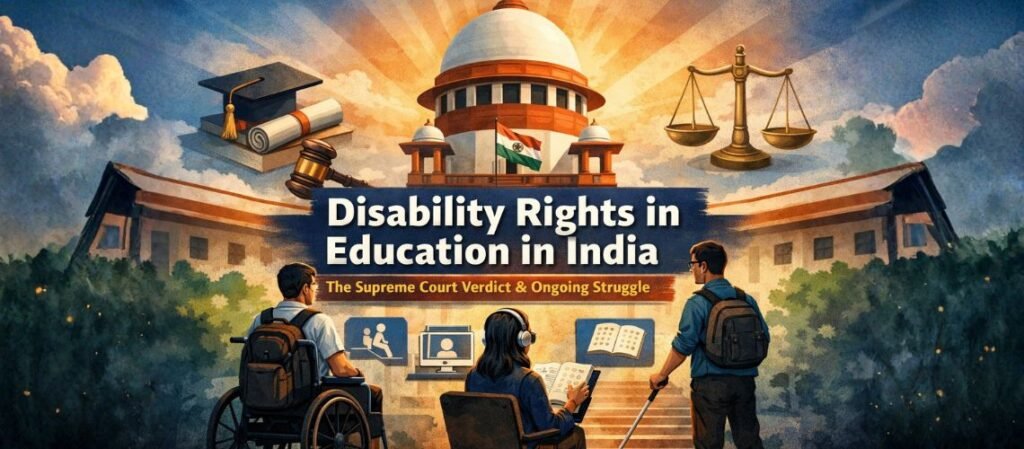
Suggested alt text: “Student with disability using assistive technology in classroom” Suggested alt text: “Accessible classroom setup supporting disability rights in education”